Showing posts with label authors. Show all posts

Sunday, 14 July 2019

MONEY SHOULD FLOW TO THE AUTHOR

Popular advice states that in any publishing relationship, money should flow toward the author. It’s easy to see how that applies in the case of notorious vanity presses like Author Solutions, Austin Macauley, and Outskirts Press, companies with a reputation for extracting as much money from authors’ pockets as possible. However, the idea that paying for any publishing service is inherently bad is emphatically not the case.

So, when should you pay to publish your book, and how does the ‘money flow toward the author’ rule apply?

A La Carte Services:
The term ‘self-publishing’ is a bit of a misnomer. Few people have the aptitude or experience to handle every aspect of a book’s production, and so most authors rely on outside help. Whether that’s hiring an editor, a cover designer, a marketing service, a distributor, or any other service.

For money to flow toward the author it doesn’t mean you should never pay someone as part of your book’s production. It only means that those services must be cost effective and add to the author’s bottom line. Authors must be confident that any money invested will return in the form of sales.

A la carte services can be essential to maximizing your book’s sales. It easy to see the value of these services when they are part of an isolated transaction. You pay a company x, you receive y, and the value received for your purchase is determined. It’s that straightforward. If the work pays for itself in a reasonable time, then money is flowing toward the author, and you have received value for your investment.

Publishing Packages:
A full-service publishing package carries a daunting price tag, and should provide a level of service that justifies the cost. Before you invest your money, look for evidence of other successful books the company has produced. Are they selling well? Do they have ample reviews? Have they reached and sustained a relatively high sales rank on Amazon?

Don’t purchase a publishing package without a clear idea of how many copies of your book you’ll need to sell to recoup the cost. And the evidence that you’ll be able to do so in a reasonable amount of time. If most of a company’s books are tumbling into the bottomless pit of obscurity, question if you can trust them to elevate yours?

All-in-one publishing packages are frequently padded with high-cost, low-value fluff, which complicates the task of evaluating whether a package is worth your investment. Watch out for items like:

  • ISBN numbers - These should be owned by the self-publishing author, and are obtainable directly from registrars like Nielsen (in the UK), Bowker (in the US) and Thorpe-Bowker (in Australia).

  • Copyright filing - There are a number of Copyright Service Companies available in the UK for copyright your draft manuscripts. Once published your work is automatically copyrighted to you. For Authors selling in the US you can register a formal copyright online for a $35 fee, in under 15 minutes. Some companies may charge hundreds of dollars for this service, then hide the cost among the rest of the publishing package services so be aware.
Inclusion in catalogues and websites:
Few services have the reach and fan base to promote your book this way, particularly an obscure small press or relatively unknown service provider. But keep in mind that quantity isn’t everything as the ultimate goal of any marketing is not just to reach large numbers of people, it is to reach the specific audience most likely to buy your book. 3 million Twitter followers won’t make a difference to your book’s sales if those followers are not interested in your genre. Or they are spammers and bots looking for a ‘follow back.’

If the publishing package you’re considering is holding these services up as valuable considerations, reflect on how much of the fee can be broken down into the discrete services whose value you know. You may be better served by an a la carte service where you can shop for the best value, and know exactly what those services are costing you.

These services may be a useful investment in the production of your book, but being able to determine whether money is indeed flowing back to the author is the key to separating a good service from a substandard one.

Pay-to-Publish Schemes: 
Readers pay little attention to the publisher or the imprint of the books they select. Factors like cover appeal, description, and reviews carry far more weight than the publisher’s name, particularly a smaller imprint that’s not widely recognized.

Under no circumstance should an author pay solely for the right to be published under an imprint. This is the essence of vanity publishing, and a key difference between a contracted self-publishing service provider and a traditional publisher. Whereas a service provider is simply performing a service for payment, traditional publishers have a greater responsibility for the works they issue.

If the ability to pay is the primary criteria used to determine whether someone will be published under an imprint, then that publisher cannot make any claim to the prestige of their imprint. And if they are curating what they publish on the basis of profitability, and are confident in the success of the book, why are they demanding the author pay?

Which brings us to the final category…

Subsidy/Hybrid Publishing:
Subsidy publishing, also known as hybrid publishing, claims to offer the benefits of traditional publishing arrangements, but requires the author to pay some or all of the publishing costs. In theory, the author receives a greater percentage of royalties in compensation.
Because there are countless bad actors attempting to reframe vanity publishing as ‘hybrid publishing,’ the ALLi Watchdog Desk advises extreme caution when presented with this type of arrangement. There are some reputable hybrid publishers and small presses operating in this way, but distinguishing this ethical minority from the exploitative majority can be quite a challenge. The ALLi Watchdog’s chief concern about hybrid publishing is that it can disproportionately shift the burden of risk onto the author without there being any compensation.

In traditional publishing, the publisher bears the responsibility for ensuring that a book is profitable. They undertake the cover design, editing, the production, distribution and other publishing responsibilities, but keep most of the book’s sales as compensation. If the publisher fails in their responsibilities and the book does not sell, it’s the publisher who takes the loss. Therefore, they have a strong incentive to ensure the success of the book.

In self-publishing, third-party service providers are responsible only for delivering the services they are contracted to perform. The transactions are clear-cut, and the provider’s obligation generally ends once the service has been delivered. The author retains overall control of the process and bears responsibility for the success, or failure of the book. They reap the rewards of their investment in the form of much greater royalties.

With hybrid publishing arrangements, the author pays the publisher up front, and thereby assumes nearly all the risk. If the publisher fails to deliver on their promises, and the book does not sell, it is the author who bears the cost, and the loss. Worse, the publisher already has their profit in hand, so has that much less incentive to invest in the book’s success. And to cap it off, many hybrid publishers also retain a significant chunk of the royalties. The author is financing the production of the book and absorbing the risk, just as they would in self-publishing, but is giving up a measure of control, sacrificing royalties, and may not receive value commensurate with the risk they’re undertaking.

Hybrid publishing is an important example of why the ‘money flows toward the author’ statement is a crucial guideline. In traditional publishing, that assurance in built into the contract. Money either flows from the customer to the publisher then to the author, or it doesn’t flow at all. And, the publisher’s profit is dependent on selling the book. But in hybrid publishing and self-publishing services, there is no guarantee built into the arrangement. And a one-way flow of cash from the author is a real and omnipresent danger meaning the author must take great care to verify that money flowing away from them will return, multiplied.

Thursday, 24 January 2019

Places to Write When You’re Fed Up with Working at Home

Do you ever get cabin fever? If you’re a full-time author, I bet you get fed up with working at home and want to find other places to write in. Here are five suggestions you might find interesting as alternatives. So, what are you waiting for? Get out and about!

1. Libraries
This one is rather obvious. You would be surprised how many authors and writers don’t consider going to their local library to work. Libraries, often have desks to work at and even a passable (free) Internet connection.

Visiting these institutions can be pleasurable as their working areas are equipped with desks, reading lamps and comfortable chairs. It can sometimes get busy, especially if your area has students close by who are using it to study (or flirt!). But if you get there early, or apply for a Reader Pass, you can find your perfect, quiet working space.

2. Theatre Cafés
A lot of authors have at some time or other used various cafés to write their masterpieces. J K Rowling wrote large parts of the Harry Potter series in The Elephant House Cafe in Edinburgh.  However, many establishments are now quite savvy (and a bit fed up) with freelancers who turn up at nine am, buy one coffee and occupy a table for the whole day. Not so in most theatre cafés.

Many Theatre Cafés can be functional, with airy architecture, and because can you stay there for any amount of time, you might spot a famous actor arriving or leaving rehearsals. It also exudes artiness with posters and works of art on its barren walls. A theatre is a useful place for a few hours uninterrupted working.

There may also be other Café’s which offer quiet places for writers. You need to investigate your local area. In mine of Cardiff Bay there is Sunflower & I, a café which offers a unique experience. Having a Bohemian style and atmosphere it is the ideal place for a writer. And it has a 16+ rule which means no children to disturb that inspirational flow.

3. Formal Gardens
This is probably not such a useful tip, especially in the midst of winter in the UK. But, if you’re on the other side of the world, or it’s summer where you are, then get to a garden to write when you’re fed up with working at home. Find a shaded bench or a leafy tree to sit under, take out your notebook or laptop and start writing.

A public garden is ideal as there’s something about the sound of nature, be it birdsong, the gentle flow of water from a pond, or the rustle of the wind in majestic trees that never fails to inspire. You can also write on the decking of your home, or in your own garden. And, if you are close to the sea, this is another special place to write.
Remember, writing places can, in themselves be inspirational.

4. Planes, Trains and Automobiles
OK, so you can’t really write in a car unless it’s a huge motor-home. However, trains and planes are absolutely the best places to get a lot of writing done. I’m not sure why this is, but I guess it’s the lack of distractions. For the number of minutes or hours, you are stuck in a seat with a table in front of you not doing anything, and poor wifi (if any), it is perfect!

5. Other People’s Homes
‘What?’ I hear your shout. Now, bear with me. We are not suggesting you sneak into other people’s homes and settle down to write a few words of your manuscript. No, no, no!

Imagine this. You are invited to a house party for the weekend, but are in the middle of a manuscript. You want to go, but are thinking of refusing the invitation.

Instead of being a party pooper, and saying, “I’d love to come for a visit, but I have to work.”

Instead say, “I’d love to come for a visit, but as I have to work would you mind if I spend a few hours writing while I’m there?” Most people won’t mind, honestly.

I know of one author’s friend who is keeping an early draft of a manuscript she wrote in her house, in case (she said ‘when’ – a true friend), the author becomes famous.

I hope I’ve given you some ideas on what to do if the walls are closing in and you are fed up with working at home.

So, what’s your favourite place to write? I’d love to know!

Monday, 5 November 2018

UNIVERSAL CREDIT THREATENS FUTURE WRITERS

According to the Society of Authors it has warned MPs that the changes to Universal Credit could silence working-class writers, impeding diversity in publishing and thus making it harder to attract different types of readers.

Speaking at the All-Party Parliamentary Writers Group inquiry into authors’ earnings on Tuesday (30th October), the SoA chief executive Nicola Solomon cautioned MPs that Universal Credit - awarded as a single monthly payment to people who are on a low income or out of work (twice monthly for some in Scotland) -could be detrimental to some authors’ income, forcing them to give up writing all together.

The SoA further explained that under the old system, currently in the process of being phased out, some authors with low earnings are able to claim working tax credits to supplement their income, thus ensuring they continue writing as a profession. But replacing this with the Universal Credit means self-employed people have to meet the “Minimum Income Floor” (an assumed level of earnings, based on what the government expects an employed person to receive in similar circumstances) in order to receive benefits. This is a threshold many writers are unable to reach. "This is equivalent to the National Living Wage for most working-age people," SoA said. "Given that the median annual income of a professional author is about £10,500, well below the National Living Wage, many authors will lose their entitlement to benefits under the new scheme."

Ms Solomon highlighted to MPs in her testimony to the inquiry that authors, including the likes of JK Rowling and 2018's Man Booker winner Anna Burns, have depended on the benefits system to support their writing. In the acknowledgements of Milkman (Faber), Burns notably gave thanks for the support of benefits from the Department for Work and Pensions that - along with the support of her local food bank, various charities and the SoA - enabled her to write her acclaimed book; sales of which reached the highest volume of any winner in the BookScan era in the week after winning the prestigious prize.

Unfortunately, claims the SoA, changes to the benefits system risks driving such working-class writers out of the industry. "From JK Rowling to Anna Burns, many authors have depended on the benefits system to support their writing. But, the design of the Universal Credit fails to recognise the reality of the work of authors or other self-employed workers in the cultural sector," said Solomon told the inquiry.

"Universal Credit risks driving working-class authors and other under-represented voices out of the profession. This would have a shocking impact on the diversity of stories being told. If writing is seen as a privilege then, only the privileged will be able to write. This gives us an incredibly narrow group of people who can afford to write, which in turn will make it harder to attract new readers and lead to a narrowing of our readership base."

NB We all know that writers are not in it for the money but this action will destroy more than just the pleasure of writing as less books produced will be detrimental to our children, grandchildren and future great-grandchildren.

Courtesy of the Society of Authors

Saturday, 8 September 2018

BACK IN THE SWING OF THINGS

So at last I am back in the UK after an extended stay 'down under' on the Gold Coast visiting family and friends. I had intended reporting back on the new people I was meeting but unfortunately circumstances didn't allow for me to do that so I am using today to catch up on what was missed. Apart from meeting the author Ally Blake I met quite a few other writers which was great, as well as linking up with fellow SCBWI (Society of Children's Book Writers & Illustrators) Members from the Gold Coast, Queensland area.

It is surprising where some writers go to offer their books for sale. Two of them I met at a local market/craft fair across the road from one of the places I was visiting. Mind you it was warm so sitting outside for a few hours wasn't too bad. As one of these writers wrote stories about their dog she had her pet on the stall with her which certainly proved to be an attraction and drew the crowds to her stall.

Despite the size of Australia it’s surprising the number of writing groups there are in the country, especially around the Gold Coast. One long standing group was The Ten Penners. They started out as a group of ten like-minded writers in 2004 and have developed their group since. The ladies I met proved to be warm and welcoming and were delighted to meet a fellow author.

Another author I met was Ally Blake. She was doing a workshop at the local library (see the previous blog Ally Blake Workshop 8th August). Ally writes for Mills & Boon and has just released book number 36. She is a well-recognised speaker and her events (I am told) are always well attended.

The other authors I met via a local SCBWI group meeting. They meet once a month at a local coffee shop to share ideas and up-date each other on what is happening in their individual writing worlds. Much the same as we do here in Cardiff where I live. Again I was made most welcome and it proved to be an interesting afternoon. Remember, if you are ever away from home always check for a local writers group or your societies meeting group as people will usually let you join in and will make you feel welcome.

And so, now I am back, it's time to get into the swing of things once again. I am seeing my publisher regarding the release of the final books in the Little Friends Picture Book Series and will be discussing what comes next. I have even started making a list of the things I want to achieve. Maybe the break away from all things writing has refreshed me? Who knows? Only time will tell.

Friday, 10 August 2018

ALLY BLAKE WORKSHOP

This is Part Two of a series of blogs I should have been writing from 1st June.
Being ‘down under’ for nearly three months visiting family means filling my time when they are working or doing their own thing. This year I decided to make some pre-arranged meetings with local Gold Coast authors and members of Queensland SCBWI – the Society of Children’s Book Writers & illustrators.
Having made my links prior to leaving the UK I was delighted to meet up with a few of the ladies from The Ten Pennies writers’ group. They have been around a few years now and have written a collective of short stories for young adults with some success. One of the ladies, Marion, invited me to join her at Broadbeach Library where the Australian writer Ally Blake was giving a Romance Writing Workshop.

                                                                                        
Ally has been a Mills & Boon UK author for some time, having just written her 36th book and regularly does these workshops. She is a very popular speaker and at only $5 (approx. £3) the two-hour event, with a cup of tea/coffee was well worth the visit. I was, along with all those attending, fortunate enough to receive a copy of the workshop notes.
The workshop was open to all and was sold out very quickly with a waiting list. I was fortunate to attend but then I did plead the cause that I was a UK author visiting Oz. Maybe that helped a little?

                                                       
                          ALLY BLAKE & MYSELF               LADIES FROM THE TEN PENNERS GROUP

As a SCBWI member I regularly attend similar workshops in Cardiff with the members of the Welsh faction and find them both enjoyable and informative. Whether you are an experienced writer or a novice such events are a benefit. So, check your local library and internet for similar workshops and go along. Apart from learning a few things you also get to meet some fabulous people.

Wednesday, 8 August 2018

JUST GO WITH THE FLOW

This is Part One of a series of blogs I should have been writing from 1st June.

Not having blogged for some weeks I thought it time to do a bit of catching up. The reason for my sloppiness is that I have been or at this moment in time still am  in Australia visiting my family. And even though I had planned on blogging while travelling the best laid plans of mice and men etc somehow never seem to work out.

My husband and I left for Oz at the end of May. The idea was he would stay for 3 weeks  during which we would celebrate the grand-daughters 18th birthday. She’s the youngest from my youngest daughter from  a previous marriage. I have to admit that I am currently on husband number 3. Maybe I’m a glutton for punishment! Who knows? Either that or I’m  just living a future novel - my life story. And what a life it’s been. However, I digress.

The first 3 weeks went well and in due course my husband returned to the UK where he quickly settled into the life of a bachelor for the next 2 months. That and visiting the two step-grand-children and doing all the grandfatherly stuff one does.

And so I duly moved in with my youngest daughter and her two, now young adults, kids. Knowing their would be times when they would be busy working or doing their own stuff I pre-organised some meet ups with local authors and members of the Queensland SCBWI Organisation. SCBWI stands for Society of Children's Book Writers & Illustrators. I’ve been an International and UK member for sometime and thought it would be nice to link up. 

This year I didn’t get a hire car as my daughter had lots of hours owed her from work so we had planned on spending time together doing girlie things. Everything was going to plan. Or so I thought.

First thing to go wrong was one of grand-daughters having a car accident. Luckily she wasn’t hurt but it meant her car has been off the road now for over 4 weeks. This means my daughter has had to run her to work and collect her in the evening. Then a couple of weeks ago the eldest daughter flew off to the UK as their father has recently come out of hospital and needs some care. This means I have limited means to see my other two grand-children who live some distance away. And finally my youngest daughter has been head-hunted for a National Managerial position. This gave her two weeks to hand in her notice and pass over all responsibility to the next person.

Despite all this excitement we did manage to get some jobs done such as a visit to the opticians, got youngest grand-daughter to an interview at TAFE (equivalent of UK after school college) and managed to fit in a couple of trips to IKEA.; My  youngest daughters favourite shop. And it didn’t cost me very much this time either!! Not to mention the odd meals out and celebrating the other grand-daughters boyfriends 21st and hers in advance as I will be back home when she turns 21. We also managed to attend to Teddy Bear’s Picnic with Teddy’s in attendance. Boy what a life they lead here down under!

And in between all this I have been reviewing and editing a very long manuscript. Hang on aren’t I supposed to be on holiday??

At the end of the day I have now decided to give up organising anything unless it’s absolutely necessary. At my age who needs the stress or worry of it? I think I will just go with the flow.

Monday, 14 May 2018

INSPIRATIONAL VISIT

Having recently spent a long week-end on the Isle of Wight I was surprised to discover how inspirational the island has been, and still is, to many writers. From Queen Victoria, who was inspired to write her letters and diaries whilst staying on the island at Osborne House to Poet Laureate, Alfred, Lord Tennyson who made his home at Freshwater in the 1850's. His home proved to be a tranquil escape from his many fans.


There were many writers, artists and illustrators who were drawn to the inspirational beauty of the island including Lewis Carroll, Edward Lear and William Allingham as well as Victorian Photographic pioneer Julia Margaret Cameron. 

Karl Marx  described the Isle of Wight as 'The Island is a little paradise,' and Lewis Carroll said it presented 'Golden summer hours and whispers of a Summer Sea.' Obviously encouraging all to write their best work.

After driving around the island in the warm sunshine I have to agree. The island is beautiful as long as you stay away from the more commercial areas. Especially if you want peace and quiet for your creative juices to flow!

There are plenty of current children's writers and illustrators who reside on the island where they write and publish surrounded by the sea. These include Jules Marriner, Zoe Sadler and Marianne Su Yin. 

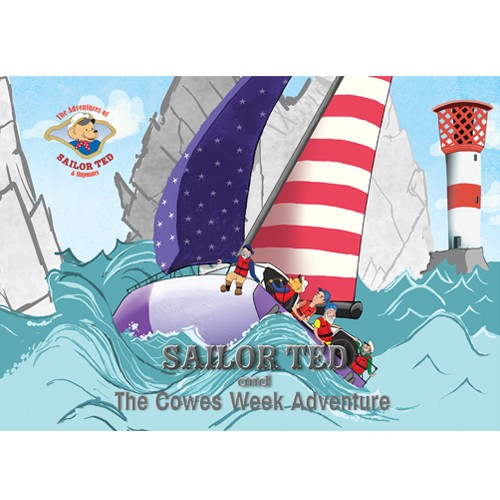
Many base their stories on the island like Frank Fenwick's Sailor Ted series. And Philip and Eleanor Bell of Island-based publisher Beachy Books, whose Jack and Boo picture books of fossils and dinosaurs, wild woods and beaches, all mirror the island's unique landscape. You only have to visit the rugged, colourful coastline of the famous Needles to understand why.


         Sailor Ted and the Cowes Week Adventure Image                   

Also living on the island and no doubt having based his fantasy tale Podkin One-Ear on the creatures living there is the 2017 Blue Peter Book Award winner Keiron Larwood.


If you are visiting the Isle of Wight then check out the Literary Heroes - An inspirational tour around the island. It shows 15 places of interest linked to assorted famous literary persons. And of course for something special why not check out the details of the Isle of Wight Literary Festival held in October. The event is based mainly at Northwood House, a Grad ll Georgian manor house set in 20 acres of parkland in the heart of Cowes.

www.isleofwightliteraryfestival.com

So where do you find your inspiration for writing from? What is it that encourages you and gives you the wonderful ideas that makes you want to sit down and write those exciting stories?

Share your ideas and help encourage other writers new to the process. 

Send to: contact@ann-brady.co.uk